• Thinking about underpinning? What GTA homeowners should know before digging down

    Thinking about underpinning? What GTA homeowners should know before digging down

    Homeowners in the Greater Toronto Area are increasingly lowering basement floors through underpinning to create full-height living spaces. Underpinning involves extending foundations deeper by excavating beneath footings in sections, allowing for higher ceilings. It is costlier and more complex than bench footing but preserves more space. Costs depend on depth, soil, water table, and existing conditions. Permits, engineering plans, and waterproofing are essential. Projects take 4-8 weeks, and neighbor communication is important.

    Continue to full article

  • Does that new-build price include the HST rebate?

    Does that new-build price include the HST rebate?

    New-home buyers in Ontario can receive up to $130,000 in HST relief on eligible purchases, but prices advertised as "exclusive of HST" do not reflect this rebate. The HST must be added first, then rebates applied, affecting the final cost. Lot premiums and upgrades can increase the purchase price and reduce HST relief, raising total costs beyond the upgrade price. Buyers should verify actual costs, including HST and rebates, before purchase.

    Continue to full article

  • GTA Homebuyers Gain More Choices as Prices Stabilize

    GTA Homebuyers Gain More Choices as Prices Stabilize

    GTA home sales in September dropped by 9% to 5,040, while new listings fell 14.4%, improving the sales-to-new-listings ratio despite declining sales. Average prices decreased 5.1% year over year, with the benchmark index down 4.7%. Active listings fell 9.3%, maintaining about 5.2 months of inventory. Average days on market rose slightly, and regional inventory varied, with Durham lowest at 3.5 months. Pricing should consider current competition and recent sales.

    Continue to full article

  • 7 easy-to-follow tips for first-time homeowners in Ontario

    7 easy-to-follow tips for first-time homeowners in Ontario

    First-time homebuyers in Ontario should get home insurance to protect their property and liability, and never skip a home inspection to avoid costly repairs. Pay off mortgages faster by increasing payment frequency. Budget for closing costs beyond the down payment, including legal fees and taxes. Obtain a written warranty that the home wasn’t used for illegal purposes. Research thoroughly using available guides and consider working with an experienced real estate agent familiar with the area.

    Continue to full article

  • Toronto Homeowners Choose Renovation Over Moving

    Slower sales and softer prices are pushing some Toronto homeowners to renovate rather than sell or move, especially households weighing space or lifestyle changes.
    Homeowners want to keep lower mortgage rates and avoid land transfer taxes, agent fees, and uncertainty about whether prices have fully stabilized.
    A contractor saw renovation inquiries ↑10% yearly, while some projects cost $15K-$25K more than a year earlier and basement remodels moved from ~$40K to ~$70K.
    Homeowners still need room for material swings, skilled-labour shortages, hidden issues in older homes, permit delays, and weeks without a full kitchen or bathroom.
    Renovating fits best for families who love their neighbourhood and need layout changes, but experts urged realistic budgets, 10%-20% contingencies, firm scope, and qualified teams.

  • Canada’s Model Tracks Mortgage Renewals

    Canada's central bank began building forecasts on a new model that gave mortgage renewals and housing supply a larger role in reading inflation.
    That shift moved Canada's mortgage renewal wave closer to the center of rate-setting, highlighting how household financing pressures now matter more in policy analysis.
    The model entered use in the previous month, a staff paper said, marking a recent change in how the central bank structures forecasts.
    The governor said the model would be the primary tool for the Oct. 28 rate announcement and the upcoming Monetary Policy Report.
    He said no model solves every problem, but this one may better fit a world shaped by supply shocks and stronger global connections.

  • Canadian Home Sales Forecast Hinges on Bond Yields

    A bank economist sharply cut Canada’s resale outlook, shifting from a much smaller forecast decline earlier in 2026 as bond yields climbed.
    National home sales are projected to ↓~5% this year, while avg. prices are expected to finish flat before a modest 2027 gain.
    The outlook assumed the central bank would stay on hold near 2%, but modest next-year gains depended on bond yields easing in current Q4.
    Support for a recovery also hinged on pent-up demand and a slowly improving job market, though the labour outlook was trimmed after trade tensions.
    Even under the baseline, next-year sales were expected to remain well below pre-pandemic levels, showing how elevated yields could extend Canada’s slower reset.

  • Ontario Real Estate Sales Slow

    In Late-Q3, local Ontario markets logged 1.1K home sales as activity moderated, while sale prices varied by location, underscoring localized conditions for buyers and sellers.
    In one Ontario county, 138 home sales closed at a ~$516K avg. price, alongside 442 new listings and 979 active listings during Late-Q3.
    Another Ontario county held steady at 118 sales, while its avg. price eased to ~$635K and homes typically took 60 days to sell.
    A third Ontario county had 31 sales, but pricing strengthened to ~$857K, with MoM gains near 27% and yearly gains near 8%.
    Industry leaders said these differences showed Ontario housing stayed deeply local, making market specific guidance important and keeping housing issues visible during municipal election season.

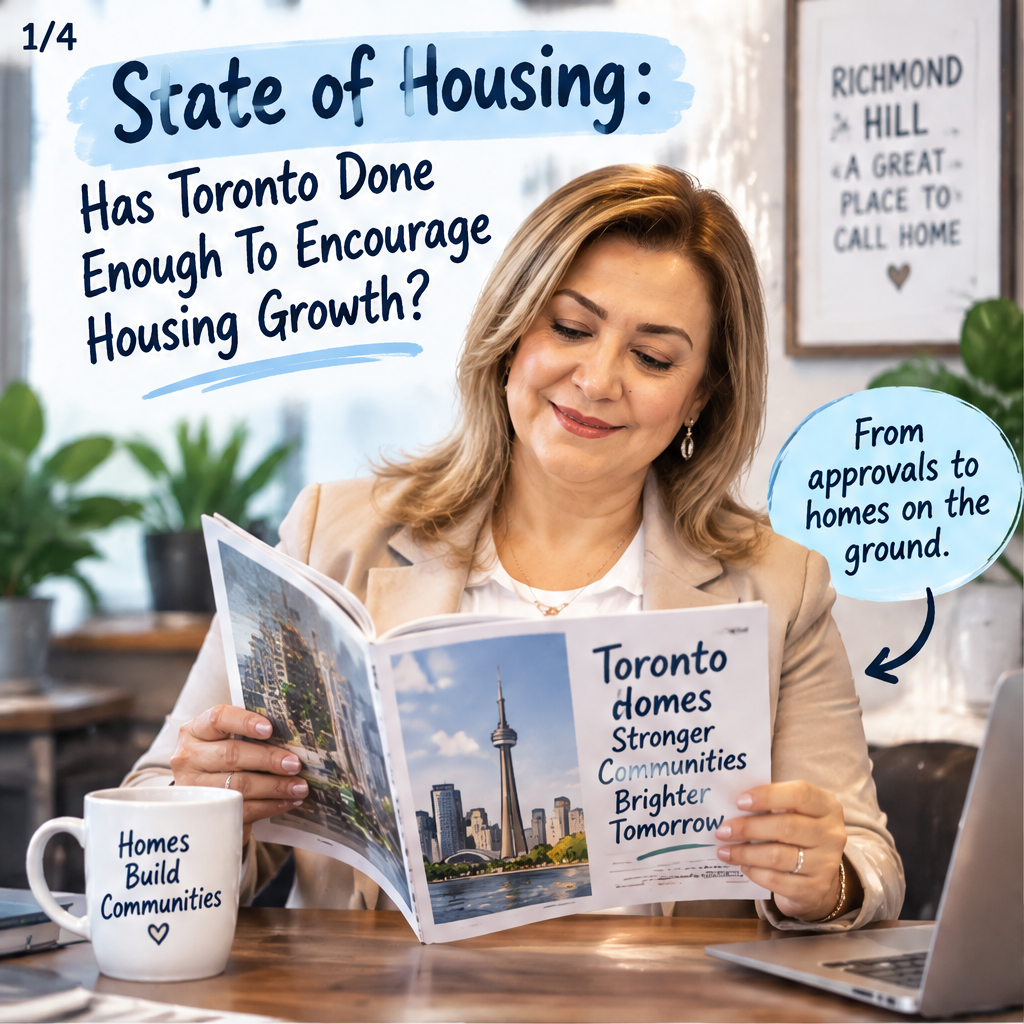
  • State of Housing: Has Toronto Done Enough To Encourage Housing Growth?

    State of Housing: Has Toronto Done Enough To Encourage Housing Growth?

    Toronto's housing challenge has shifted from approvals to getting approved projects built. The city has reduced development charges, introduced incentives, increased housing density allowances, and reformed the development review process. However, financing, infrastructure, labor, and market conditions remain hurdles. Coordination with other governments and predictable policies are crucial. The next Council must focus on converting temporary relief into lasting reforms to ensure housing projects move from approval to construction.

    Continue to full article

  • Ontario Buyers Could Save $130K on HST

    The province proposed removing HST on most new homes, combining provincial and federal support to lower purchase costs for eligible buyers across Ontario.
    Buyers of new homes priced at $1M or less would receive full relief, with potential savings reaching up to $130K under the proposal.
    Homes from $1M to $1.5M would still qualify for the maximum rebate, while higher-priced homes would see relief gradually reduced above that range.
    Officials said the measure could add ~8K housing starts in 2027, support up to 21K jobs, and strengthen Ontario's economy through construction activity.
    Applications are not open yet; buyers purchasing eligible homes from April 1, 2026 through March 31, 2027 can apply after program launch.